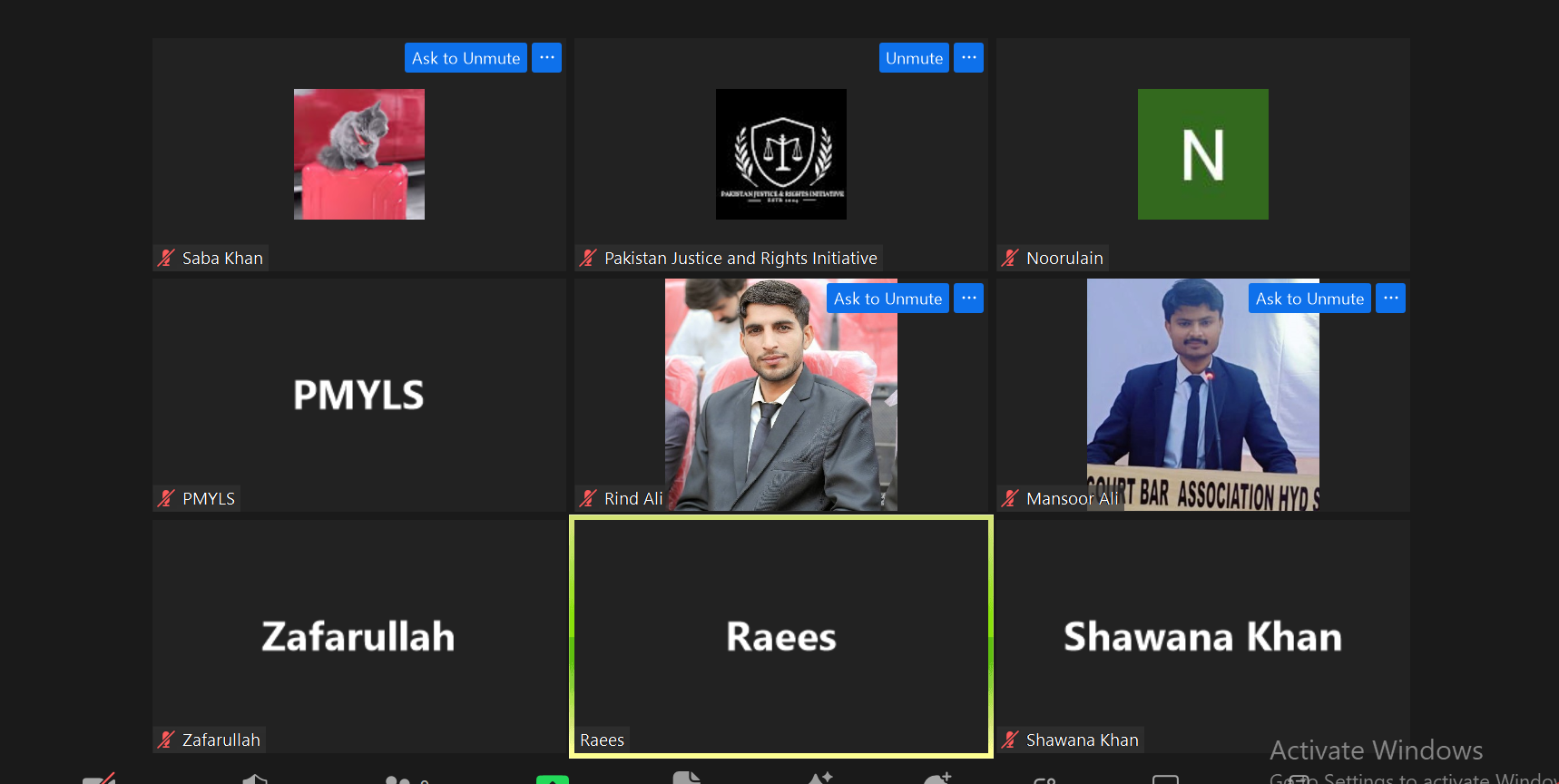
Discussion Summary:
The session was convened to discuss critical human rights issues in Pakistan, primarily enforced disappearances, as well as bonded labor and marginalization/resource disparity.
Key Arguments and Points Raised:
1. On Enforced Disappearances and the Rule of Law:
The practice was described as a fundamental violation of the rule of law and the constitutional principle of habeas corpus. The state, when conducting an enforced disappearance, acts without any legal authority or law to justify its action.
It was argued that the state operates with impunity, creating a culture where it places itself above the law. The state does not admit to these actions because it cannot cite a supporting law.
The act was defined as the state making people "ghosts" – taking them away without acknowledgment, leaving families in limbo.
Participants noted that even when the state might have suspicions or evidence against an individual, the legal, constitutional path is to produce them before a court. Enforced disappearances bypass this entirely.
References were made to constitutional articles (Article 4, 9, 10, 14) that guarantee rights to security, fair trial, and protection from unlawful detention, which are violated by this practice.
2. Root Causes and Broader Context:
Enforced disappearances were linked to a broader state culture of marginalization and resource disparity.
A participant from Balochistan highlighted that the root cause in the region is the perceived and actual deprivation of resources and rights. The state's failure to provide basic rights, education, and a share in natural resources leads to alienation and rebellion.
The issue was connected to the centralization of power and an insecure state that seeks excessive control, particularly over peripheral provinces like Balochistan and Khyber Pakhtunkhwa (KPK).
It was suggested that the state uses enforced disappearances as a "shortcut" when it perceives a threat to its narrative or interests, often targeting human rights activists, journalists, or those demanding rights.
Discussion touched on ethnic tensions (e.g., Baloch, Sindhi, Punjabi), stating these are often exacerbated by the state's policies and failure to ensure equitable treatment and development for all groups.
3. Governance and Resource Distribution:
Participants discussed the inequitable distribution of resources and federal funds, noting that provinces like Balochistan, despite their resource wealth, receive a smaller share and have less representation.
This economic and political marginalization was seen as fuel for discontent and, in response, state repression.
The lack of strong, transparent institutions and accountability mechanisms allows such practices to continue without oversight.
4. Role of Citizens and Non-State Actors:
One participant emphasized that silence is complicity; neutrality in the face of oppression means siding with the oppressor.
A point was raised about the role of non-state actors in conflicts and disappearances, though the discussion remained focused on state responsibility.
The importance of public awareness and reporting missing persons to police stations was mentioned, though the failure of the state to follow legal procedures thereafter was critiqued.
5. Potential Solutions and Actions:
Long-term solutions require addressing root causes: equitable resource distribution, granting true provincial autonomy, and ending discriminatory policies.
At a societal level, participants stressed the need to educate younger generations to recognize each other as humans beyond caste, ethnicity, or province to build national cohesion.
As individuals and law students, participants identified advocacy, using legal forums, writing, and raising awareness as immediate actions.
In a democracy, the power of public consent was mentioned as a theoretical check on state power, though the practical challenges were acknowledged.
Conclusion:
The session concluded without a definitive solution but emphasized the importance of continued discussion, awareness, and advocacy. The moderator encouraged participants to keep engaging with these issues and reconvene for future discussions. A request for participation certificates was declined, with the moderator emphasizing that the value of the session was in the exchange of ideas, not formal certification.
Topics Covered:
- Enforced Disappearances
- Rule of Law and Constitution (Habeas Corpus, Articles 4, 9, 10, 14)
- State Impunity
- Bonded Labor
- Marginalization and Ethnic Discrimination
- Resource Disparity and Provincial Rights
- Governance and Accountability
- Role of Citizens and Youth